

You’ve seen it. A friendly business portrait or headshot that makes you want to pick up the phone. Another one, while technically fine, well-lit and professionally shot, leaves you cold. The difference isn’t always obvious. But it’s there, and it’s not accidental.
Friendly business portraits generate calls. The difference between a portrait that works and one that doesn’t often comes down to crop. Here’s the psychology.
It’s Not About the Smile
The instinct is to attribute warmth to expression. Smile more, look approachable, relax your shoulders. And yes, those things matter. But two friendly business portraits with identical expressions can read completely different depending on how much of the person you can see… and how close the camera appears to be.
You might think it’s intuition, but it’s actually psychology at work.
The Science of Personal Space
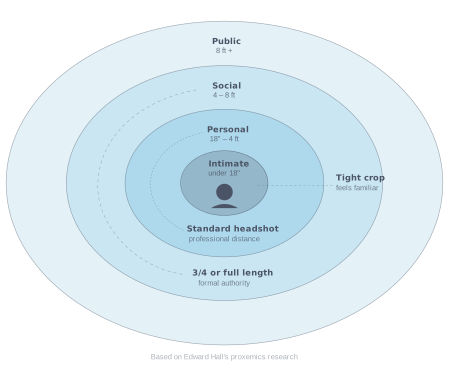
Researcher Edward Hall identified four distinct zones of interpersonal distance that govern how we relate to other people. Strangers interact comfortably at four to eight feet. Acquaintances and new business contacts occupy what Hall called “personal space”… two to four feet. Close friends and family operate within eighteen inches.
These aren’t arbitrary numbers. Proxemics is the study of how humans use physical space in their interactions with others — and what those spatial relationships communicate. Hall’s research established that the distances we maintain from other people aren’t random. They’re a consistent, largely unconscious language that signals intimacy, familiarity, or formality depending on how close we allow someone to get.
They’re hardwired into how we read other people. And a portrait replicates them.
Three Crops. Three Psychological Signals.
A three-quarter or full-length portrait on white seamless reveals more of the person… how they carry themselves, how they dress, how they occupy space. For support staff, paralegals, and client services teams, the wider crop works in their favor. Their prospects read it as personality. Approachable. Knowledgeable. The kind of person who will actually call them back. Not the person they’re engaging on the serious questions, but someone they feel good about dealing with at your firm.


For leadership, three-quarter length works differently and usually requires context. A senior partner photographed in their environment, at their desk, in a boardroom, in front of a window with the city behind them, carries environmental authority that a seamless backdrop can’t replicate. The wider crop plus the setting signals to a prospect: this person belongs here.
A standard headshot – shoulders visible, a little space above the head – puts the prospect at roughly personal space distance. Approachable. Professional. Close enough to feel like a real interaction, far enough to remain appropriate. This is where most professional portraits live, and for good reason.
A tight crop – the frame cutting into the sides of the head, face filling most of the image – replicates the visual angle of someone eighteen inches away. That’s intimate space. A prospect’s brain reads it as familiarity whether or not they’ve ever met the person. Done well, it’s disarming. The attorney or advisor feels known, warm, safe to call. The prospect can’t quite put their finger on why, but they want to pick up the phone… That’s not charm, that’s crop.


Done wrong, or used for the wrong person, it’s overbearing. A senior partner whose authority needs to land before their warmth does doesn’t benefit from a portrait that puts their prospect in their personal space uninvited.
A Practical Takeaway For The Friendly Business Portrait
Before the shoot, the question isn’t “how should we smile.” It’s, “What does this person need their portrait to do? Who’s looking at it, and what do they need to feel?”
For a business development attorney trying to seem approachable to new clients, it’s a standard headshot, or tighter.
For the named partner whose reputation preceded them by twenty years, give them room.
Same firm. Same shoot day. Different crops. Different psychological signals.
That’s not something a camera does automatically, it’s something a photographer decides deliberately… and the end result? Friendly business portraits: Inviting. Confident. Real.
Frequently Asked Questions
It comes down to crop. The tighter the frame, the closer the camera appears to be — and the closer the camera appears, the more familiar the subject feels to the viewer. This replicates the psychological signals of physical proximity, making the person in the portrait feel known and approachable even to someone who has never met them.
Proxemics is the study of how humans use physical space in their interactions, and what those spatial distances communicate. Researcher Edward Hall identified four zones of interpersonal distance, from public space at eight feet or more to intimate space under eighteen inches. A portrait crop replicates these distances visually, triggering the same psychological responses as physical proximity.
It depends on the role. For client-facing staff and business development professionals, a standard headshot or tighter crop creates approachability. For senior partners and named executives whose authority needs to land first, a wider crop with more space gives the portrait the gravitas the role requires. The crop is a strategic decision, not just an aesthetic one.
Yes,and it works below the level of conscious thought. A prospect scanning a firm’s team page isn’t analyzing portrait crops. They’re forming instinctive impressions. A tight crop creates a sense of familiarity that translates directly into a feeling of comfort… and comfort is what makes someone pick up the phone. That’s not charm. That’s crop.